Interfaces of Reality
Book overview
More on YouTube @interfacesofReality.
Reality is structured by boundaries
Reality organizes itself through interfaces: boundaries that constrain interaction while enabling coordination. These interfaces stack hierarchically—each layer builds on those below—so new behavior emerges through accumulated constraints, not by replacing what came before.
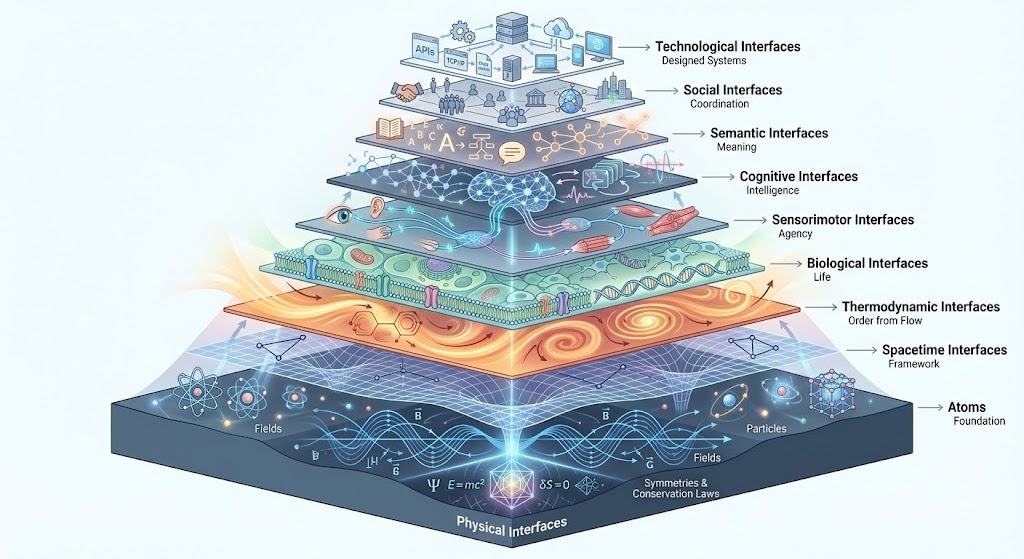
Explore each layer
Nine stops from the foundations of physics to consciously designed systems. Each page is a short guided tour—open any card to go deeper.
Physical Interfaces
The Foundation of Reality
Symmetries, conservation laws, fields, and particles. The most fundamental level of reality, before life or mind enter the picture.
- Symmetries as source code
- Conservation laws as boundaries
- Fields and particles as stable patterns
Thermodynamic Interfaces
Managing Entropy, Creating Order
Interfaces that allow entropy to be exported while maintaining local order. Enables complexity to emerge from simple processes.
- Entropy management
- Dissipative structures
- Far-from-equilibrium systems
Spacetime Interfaces
The Framework of Interaction
Creates the framework within which everything else operates. Establishes locality and causality.
- Locality constraints
- Causality structure
- Foundation for all interaction
Biological Interfaces
Self-Maintaining Boundaries
Introduces active self-maintenance. Membranes, regulatory networks, and metabolic pathways that maintain life.
- Cell membranes
- Active self-maintenance
- Autonomy and persistence
Sensorimotor Interfaces
Bridging Organism and Environment
Perception and action loops that enable agency. Active engagement with the world.
- Active perception
- Purposeful action
- Emergence of agency
Cognitive Interfaces
Creating Intelligence and Selves
Predictive models, Markov blankets, and inferential processes. Creates intelligence and the self.
- Markov blankets
- Predictive models
- Hierarchy of selves
Semantic Interfaces
Stabilizing Meaning Across Systems
Language, symbols, and ontologies that enable meaning to stabilize and be shared. Creates knowledge and culture.
- Shared meaning
- Language as boundary
- Ontologies as contracts
Social Interfaces
Coordinating Behavior Across Individuals
Norms, institutions, and legal frameworks that enable cooperation and collective action.
- Social norms
- Institutions
- Collective action
Technological Interfaces
Consciously Designed Systems
APIs, protocols, and user interfaces explicitly designed by humans. Shows how we can consciously design what nature discovers.
- APIs and protocols
- User interfaces
- Conscious design