Conscious Design
Technological interfaces differ from natural interfaces in that they are consciously designed. Engineers and designers create APIs, protocols, and user interfaces with specific goals in mind. Yet, the best technological interfaces often rediscover patterns that appear naturally in biological, cognitive, and social systems.
APIs and Protocols
Application Programming Interfaces (APIs) are technological interfaces that enable different software systems to communicate. Like biological membranes, APIs create boundaries that allow selective exchange. They define what information can pass, in what format, and under what conditions.

As shown above, this shows how a car's interface shields users from complexity. You don't need to understand the engine, transmission, or electrical systems to drive a car, the interface (steering wheel, pedals, dashboard) provides everything needed for effective interaction. This demonstrates a key principle of good interface design: minimality. The interface exposes only what matters for the user's goals while hiding the underlying complexity. This same principle applies to APIs, which shield developers from implementation details while enabling effective communication between systems.
Protocols are interfaces that govern how systems interact. HTTP, TCP/IP, and other network protocols create the conditions for the internet to function as a coherent system despite its distributed nature.
User Interfaces
User interfaces are technological interfaces that bridge the gap between humans and machines. They translate human intentions into machine actions and machine states into human understanding. Good user interfaces follow the same principles as natural interfaces: they constrain interaction while enabling coordination.
Like sensorimotor interfaces in biology, user interfaces create loops between perception and action, enabling humans to effectively engage with technological systems.
Interface Design Principles
The principles that govern natural interfaces also apply to technological ones. Good engineered interfaces start from coordination needs rather than exhaustive representation, stay minimal at the boundary, and separate a stable core from extensions that can move as requirements change.
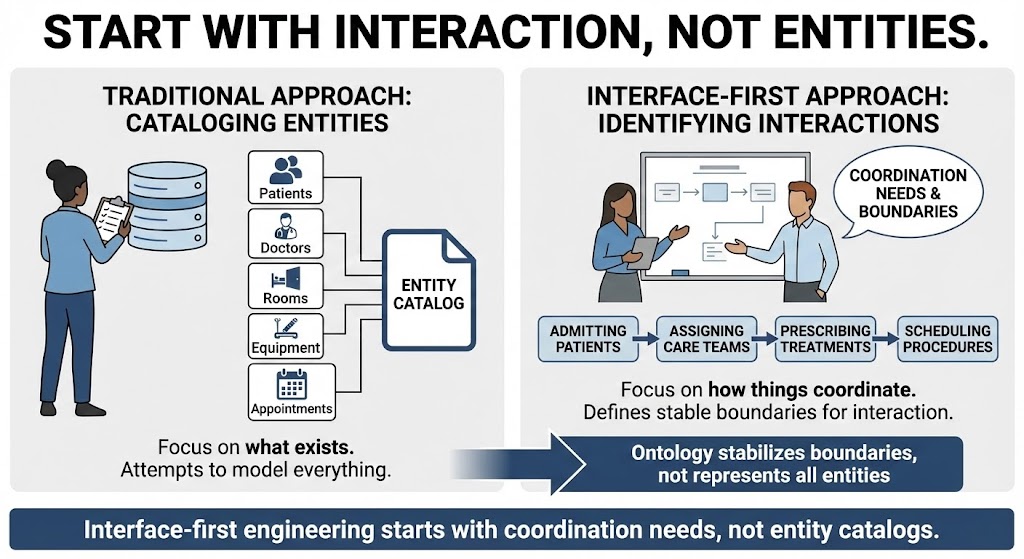
As shown above, interface-first engineering contrasts cataloging every entity with identifying the interactions that must stay reliable. APIs, protocols, and products that ship on time usually get this direction right: stabilize what coordination depends on, push everything else behind the boundary.
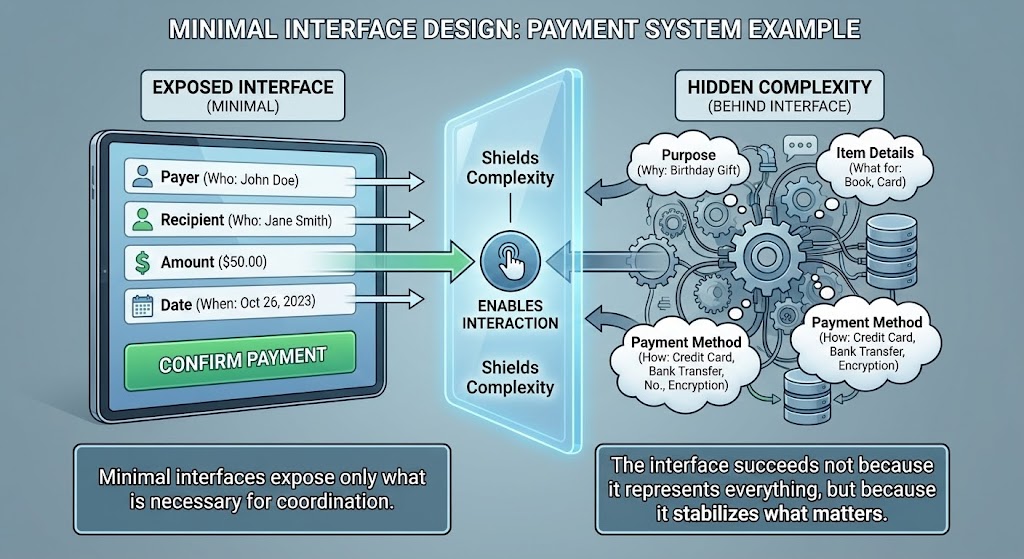
As shown above, minimal interfaces expose only what callers or users need at the boundary. Extra surface area is not neutral; it is coupling. Technology fails in the same ways natural systems do when the boundary tries to carry too much detail.
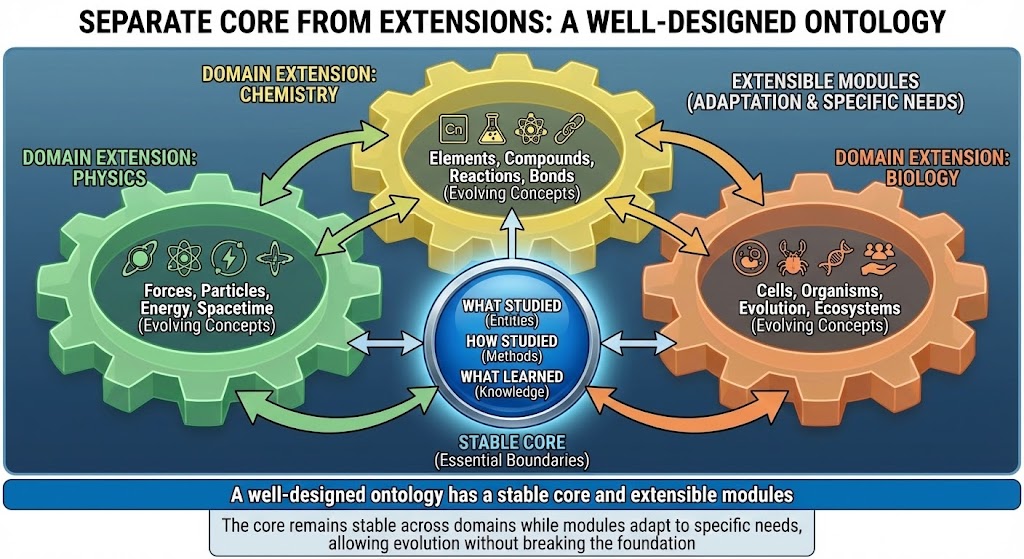
As shown above, a stable core with explicit extension points is how engineered systems stay coherent as they evolve. That is the same pattern as robust natural interfaces: identity persists because the commitments at the boundary stay legible while the internals change.
Key Concepts
- APIs: Interfaces that enable software systems to communicate
- Protocols: Interfaces that govern system interaction
- User Interfaces: Interfaces that bridge humans and machines
- Conscious Design: Explicit creation of interfaces
- Interface Principles: Minimality, stability, coordination
- Engineered Systems: Complex systems enabled by designed interfaces
Building on All Previous Layers
Technological interfaces build upon all previous layers. They rely on physical interfaces for stability, biological interfaces for inspiration, cognitive interfaces for usability, semantic interfaces for meaning, and social interfaces for coordination. They show how the principles discovered by nature can be consciously applied to create new possibilities.