Life as a Boundary-Maintaining Process
Life does not begin with genes, cells, or reproduction. It begins with something far more fundamental and far more fragile: the ability to maintain a boundary. A living system must maintain a separation between itself and the environment.
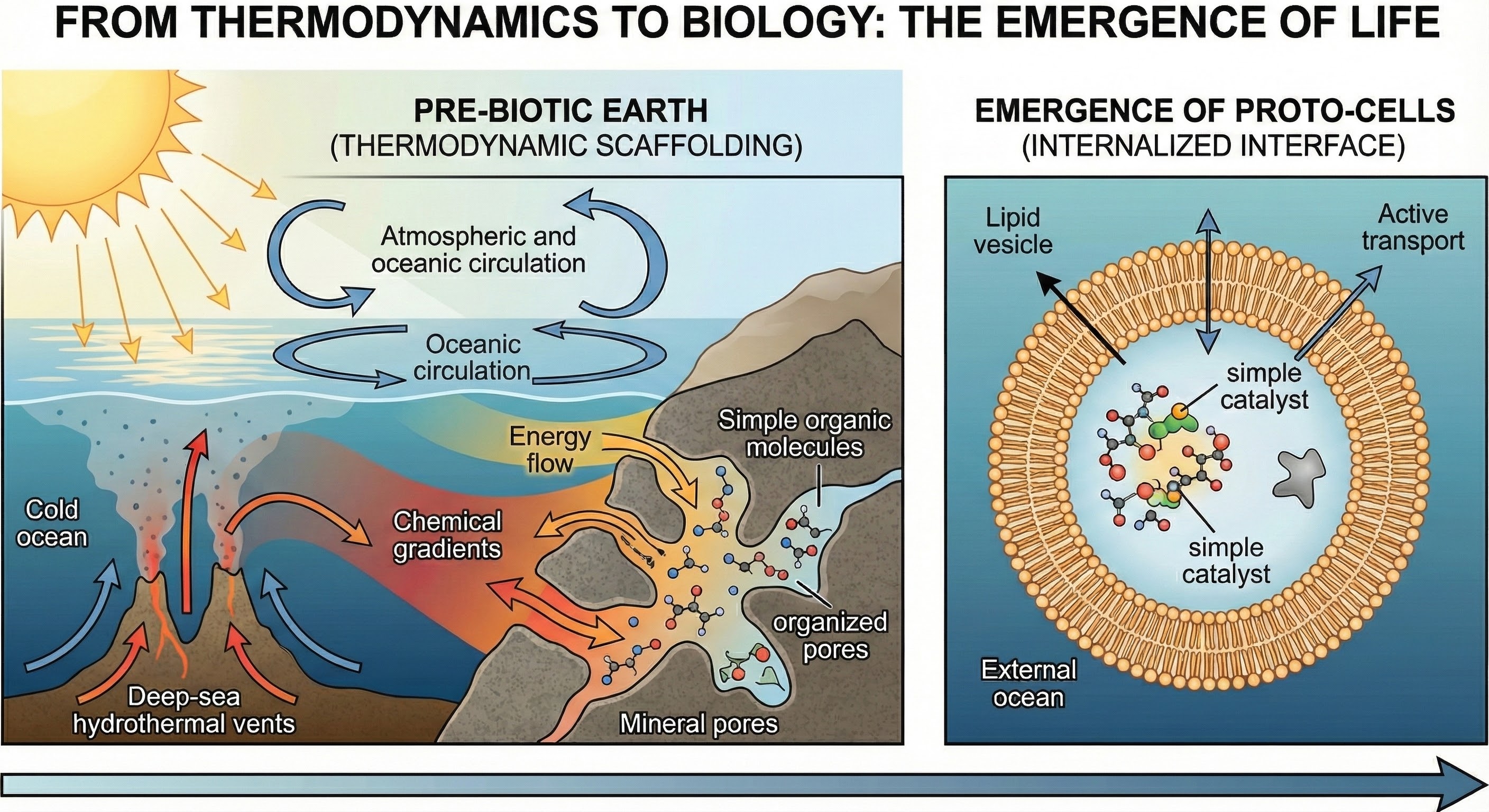
As shown above, this captures the profound transition from non-living to living systems, the emergence of self-maintaining boundaries. The first biological interfaces were likely simple lipid membranes that could maintain a separation while allowing selective exchange. This moment represents the birth of autonomy: systems that could actively maintain their own existence rather than passively responding to their environment. The interface here is the membrane itself, which creates the boundary that enables life to persist.
This separation is not absolute. Life depends on exchange. Matter, energy, and information must flow in and out. But the flow must be regulated. Too much openness and the system dissolves. Too much closure and it starves. Life exists in the narrow region between these extremes.
The Cell Membrane: More Than a Wall
The cell membrane is often introduced as a simple boundary: a lipid bilayer that encloses the cell. This description dramatically understates its importance. The membrane is not just a barrier; it is a sophisticated interface that selectively allows certain molecules to pass while blocking others.
When a cell dies, the molecules do not disappear. The atoms remain. What changes is that the boundary is lost. The membrane breaks down, and the cell's contents mix with the environment. The cell ceases to exist not because its parts are gone, but because the interface that maintained its identity is gone.
Active Self-Maintenance
Biological interfaces do not merely constrain interaction. They actively maintain themselves. This is what distinguishes biological interfaces from physical ones. A physical interface, like a crystal structure, is stable but passive. A biological interface actively works to maintain its own stability.
This introduces something new into the universe: responsibility for persistence. A rock does not care whether it exists tomorrow. A living system does. It actively maintains the interfaces that keep it alive.
Key Concepts
- Cell Membranes: Selective boundaries that maintain separation
- Regulatory Networks: Interfaces that filter and process signals
- Immune Systems: Interfaces that distinguish self from non-self
- Metabolic Pathways: Interfaces that maintain chemical gradients
- Self-Maintenance: Active preservation of boundaries
- Autonomy: The ability to persist through self-regulation
Building on Previous Layers
Biological interfaces build upon all the previous layers. They rely on physical interfaces for stability, thermodynamic interfaces for energy management, and spacetime interfaces for separation. But they add something new: the ability to actively maintain these interfaces, creating the conditions for life to persist and evolve.