Inferential Interfaces
Cognitive interfaces are inferential interfaces. They maintain models of the world that enable prediction and action. These models are not static representations, but dynamic boundaries that organize how partial sensory information updates internal states and how actions close the loop with the environment.
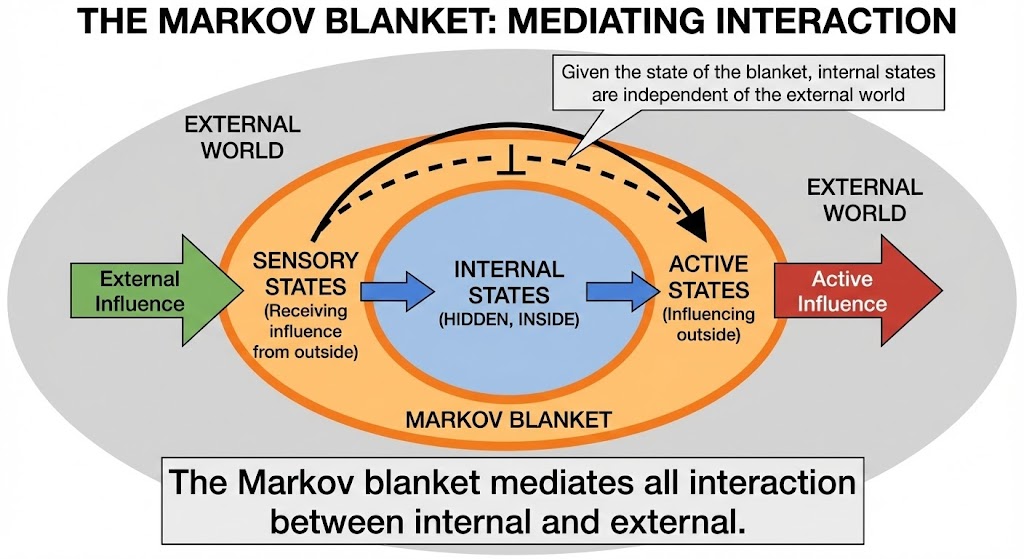
As shown above, a Markov blanket is the minimal structure of that arrangement: internal states are screened from the external world by sensory and active states on the boundary. Given the blanket, inside and outside are conditionally independent, which is exactly what makes inference instead of raw coupling possible.
When predictions fail, the interface must update. When expectations conflict, the interface must resolve the conflict. This active maintenance of coherence is what creates intelligence.
Markov Blankets and the Self
A Markov blanket is an inferential interface that separates internal states from external states. It maintains a boundary that shields internal coherence from external noise while allowing selective exchange of information.
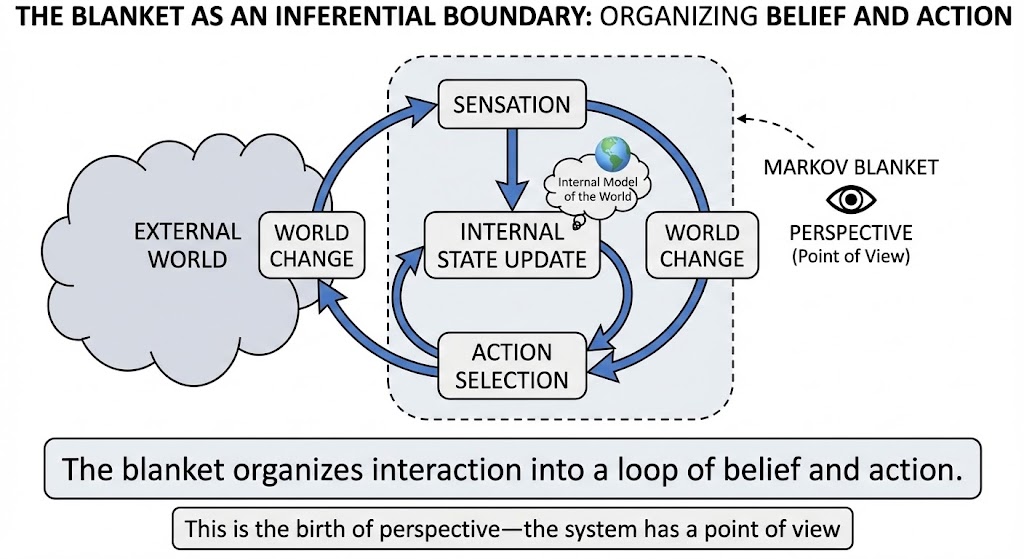
As shown above, the blanket organizes inference into a loop: sensation updates internal states, internal states select actions, actions change what returns on the next sensation. The system behaves as if it has a model of the world even when no explicit model is written down anywhere.
The self we experience is not a single blanket, but a stack. We have a sense of self at the level of our body, our mind, and our social identity. Each of these is a Markov blanket, organizing inference at its own scale.
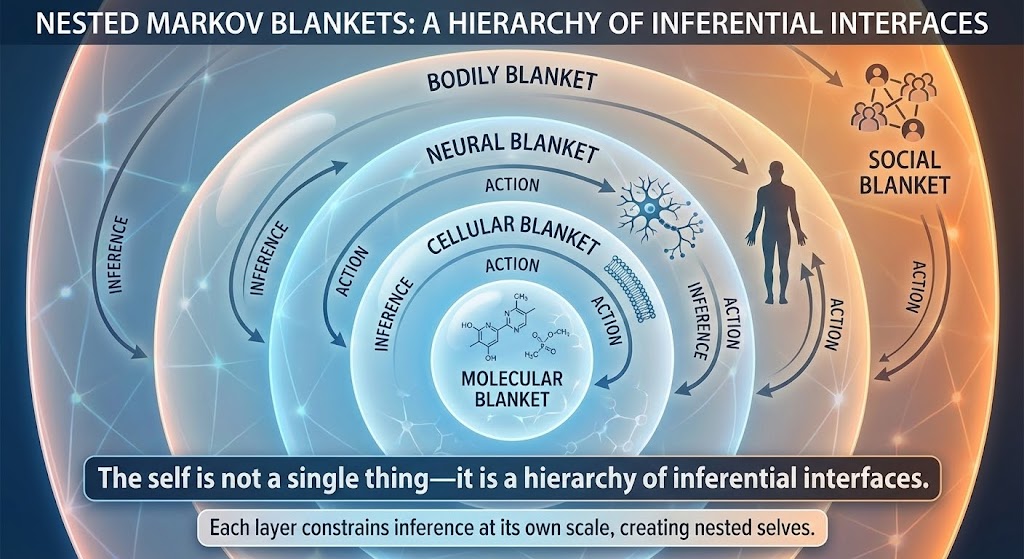
As shown above, blankets nest: molecular, cellular, neural, bodily, social. Coherence at one scale depends on coherence at the scales below. Intelligence does not require a single central controller; it requires interfaces that keep each level stable enough for the next to function.
Models, Perspectives, and Experience
Once inference is in play, the boundary between model and world becomes subtle. Internal states do not mirror the world; they track what matters for maintaining the interface. Different organisms in the same place can inhabit different actionable worlds because their blankets organize different sensory channels and goals.
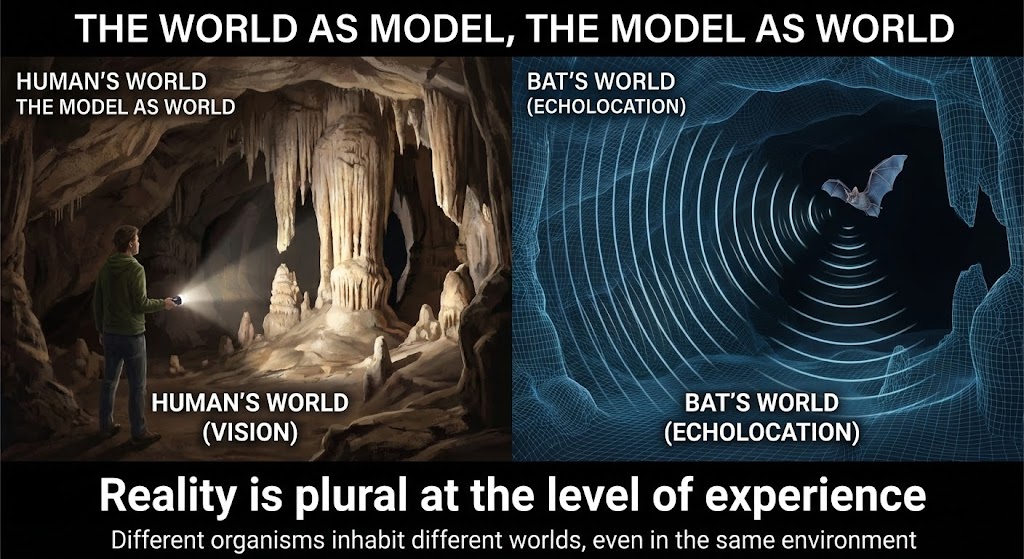
As shown above, the same physical environment supports different constructed worlds when interfaces differ. Selectivity is not a flaw of cognition; it is how finite systems stay viable in an inexhaustibly rich environment.
This filtering is not arbitrary. It is constrained by the organism's models, its goals, and its current state. What gets emphasized is whatever the boundary must stabilize for the organism to keep acting and persisting.
Key Concepts
- Predictive Models: Interfaces that maintain coherence between expectations and reality
- Markov Blankets: Inferential interfaces that separate internal from external
- Selective Experience: Different interfaces construct different actionable worlds from the same environment
- Inferential Processes: Navigation of possibility spaces
- The Self: Hierarchy of inferential interfaces
- Free Energy Minimization: Principle that maintains coherence
Building on Sensorimotor Interfaces
Cognitive interfaces build upon sensorimotor interfaces. They rely on the perception-action loop established at the sensorimotor level, but add the ability to maintain models, make predictions, and navigate possibility spaces. This creates the conditions for intelligence and the emergence of selves.